Saturday, September 16, 2017

CliftonStrengths


CliftonStrengths is a better brand name than StrengthsFinder. In my understanding, it’s 20% scientific and 80% marketing. The things to take away is:
  1. refine my dictionary of 34 words — so-called “talent themes”.
  2. the way they pose questions are actually more interesting/mind invoking. such as light-hearted/serious, planning/go with flow, keep absorbing info/simplifying complexities, equally/selectively to friends, winning/get things right is everything.
  3. not surprising, my top 5 is learner, intellection, input, deliberative, connectedness
Donald O. Clifton (February 5, 1924, in Butte, Nebraska[1] – September 14, 2003)[2] was an American psychologist. He developed the eponymous Clifton StrengthsFinder, Gallup’s online psychological assessment. Clifton was professor of educational psychology at the University of Nebraska-Lincoln from 1950 to 1969[2] when he founded Selection Research, Inc. (SRI) that grew to the point where in 1988.
*StrengthsFinder* (or *Now, Discover Your Strengths*) is a self-help book written by Marcus Buckingham and Donald O. Clifton, first published in 2001. At the heart of the book is the internet-based “Clifton Strengths Finder,” an online personal assessment test that outlines the user’s strengths. The authors advocate focusing on building strengths rather than focusing on weaknesses.
The Gallup Organization claims to have distilled the theory into practice by interviewing 1.7 million professionals from varying fields.[1] Having quantified the different traits of the people they interviewed, they came up with 34 distinct patterns—what they call “talent themes”.
Jim Clifton is the son of Donald Clifton, they are CEO and chairman of Gallup. Tom Rath’s 1st book, How full is your bucket, coauthored with his grandfather, Donald Clifton.
Wellbeing: The Five Essential Elements (2010), a New York Times bestseller, coauthored with Jim Harter, is based on Gallup’s research on wellbeing. The book lists five elements of well-being as: career wellbeing, social wellbeing, financial wellbeing, community wellbeing and physical wellbeing
Criticism vs response:
  1. Nobody I’ve seen talk about strengths—not Gallup or Marcus Buckingham—promote a strengths-only approach. They do promote the benefits of a strengths-based approach that focuses mostly on strengths
  2. Raw talents—often seen in young people (which is to be expected), or people with low self-awareness—aren’t augmented with much knowledge, skill, or life experience. That’s when you people with attention to detail traits in leadership positions micromanaging (any decent leader knows it’s not effective to micromanage people). Mature talents *are* augmented with knowledge, skill, and life experience. You see these in action when you see people who are really good at what they do who also have a positive reputation. They have learned, over time, how to express their talents constructively in the environments they find themselves in.
  3. “ Weaknesses matter” - The book never says to ignore weaknesses, and instead suggests one should manage around their weaknesses, and gives ideas for how to do this
The findings show that everyone has some combination of a list of only 34 basic strengths. You can discover your top 5 strengths online using a 177 question assessment.
Knowing what the 34 themes are before you take your assessment can skew your own results. You cannot unlearn these talents and only have one shot at doing an unskewed assessment before learning more about the 34 themes.
Strength = talent + knowledge + experience
34 strengths are first formulated in (https://en.wikipedia.org/wiki/Now,_Discover_Your_Strengths) in 2001.
Myers–Briggs Type Indicator: https://en.wikipedia.org/wiki/Myers%E2%80%93Briggs_Type_Indicator It is similar to Carl Jung’s 4 cognitive functions.

StrengthFinder 2.0 excerpt

At its fundamentally flawed core, the aim of almost any learning program ti to help us become who wer are not.
Overcoming deficits is an essential part of the fabric of our culture. Unfortunately, this is taking the path of most resistance.
“ You can be anything you want to be, if you just try hard enough” is a misguided maxim. You can’t be anything you want to be. YOu can be a lot of who you already are.
One big problem is that most people are either unaware of, or unable to describe, their own strength.
These 34 themes represent our best attempt at creating a common language or classification of talents. By no means did we capture everything.
Although people certainly do change over time and our personalities adapt, scientists have discovered that core personality traits are relatively stable throughout adulthood, as are our passions and interests.
Building your talent into real strengths also requires practice and hard work, much like it does to build physical strengths.
Adding raw talent is a very different story. While it may be possible, with a considerable amount, to add talent where little exists, our research suggests that this may not be the best use of your time.
Blind spot. Be more conscious of any “blind spot” caused by your talents. For example, Strong Command may not realize the damage left in our wake as we are pushing to get things done each day. Consistency talent focus so much on keeping steps uniform that they ignore the overall outcome and goals.
34 themes describe a great deal of the variation in human talent, they don’t capture many nuances of unique personalities. e.g. Learner may learn from reading books, learns primarily from doing or from an insatiable curiosity.
The purpose of CliftonStrengths is not to anoint you with strengths, but helps you find the area where you have the greatest potential to develop strengths.

StrengthFinder test

  • Natural behavior is your talent and greatest potential.
  • You don’t stop initiators. You ask well-designed question to let him rethink the approach.
170 paired descriptor, 20 seconds for each pair, 45 minutes. Cost for Top 5 - $19
examples:
  • humanity/ambitious
  • Contest/work
  • make people success/happy
  • carefree/mature
  • leader/team player
  • history/future
  • work as life/earn money
  • organize/analyze
  • listen to people/ highlight their important points
  • philosophical/ hardworking,achieving
  • make other feel worthwhile/successful
  • solve problems/ use information
  • tell stories/ give advice
  • great stamina to work longer/ not driven to work harder
  • athletics vs thought
  • tidy/stubborn
  • I grow when I share/learn
  • in the future what I can achieve/ how I will respond
  • relate to others better when I find their weakness/goals
  • include everybody/ select friends carefully
  • very important to be recognized as credible, professional/ego not so large
  • I progress by capitalizing talents/ overcoming weakness
  • plan/ go with the flow
  • do things in different ways/routine ways
  • I hate it when I cry/ tears are a part of my life.
  • enjoy relaxing/cleaning
  • happiness is money/ not about money
  • treat people equally with clear rules to follow/ discover what is unique about each person and motivating them individually
  • rely on experts to find right answer/ answers and issues emerge naturally
  • generous in giving praises/ selective
  • stay in comfort zone/ thrill seeker
  • sense the feeling of others/ discuss big ideas
  • for important decision, I trust my heart/my head
  • I respond to things as they occur/ I prioritize things, then act
  • I like to take care of the present/ live for the future
  • I force myself to study/ I can concentrate on the things in which I am interested.
  • I like anything dealing with little children/ I prefer to deal with adults
  • I study what makes others tick/ I am introspective
  • I like to be heard/ I like to listen
  • I am satisfied with my progress in life/ worry about my future
  • I like to talk/think
  • I want to get things perfect/done
  • I am a down-to-earth thinker/ creative,strategic thinker
  • I choose friend honest about my weakness/ appreciate my strength.
  • I am never at a loss for words/ hard for me to talk about myself.
  • I love to study/ live to go out.
  • I am often forgetful/ My nature is to check everything in order
  • my way for achieving: overcoming weakness/building on my talent
  • I am outgoing/ I can be outgoing when I need to be
  • I want as many friends as possible/ I want a few deep friendships
  • I like to challenge people/encourage people
  • I am a very private person/ My life is an open book
  • I sometimes flatter others/ I am conscientious
  • I am generous with my praises/ It really means something when I praise
  • I am open to learning new things/ My values are stable
  • I enjoy philosophical discussion/ I enjoy goal setting conferences
  • I visualize the future/ I understand what cause present circumstances
  • last minute pressure focuses my think/my thinking it clearer when I get things done ahead of time
  • I do the best I can/ I am driven to make a difference
  • I seek responsibility/I strive for promotion
  • I am agreeable with people/ I take risks
  • I inspire friends to make things happen/bring harmony
  • I am light-hearted/serious
  • It is easy for me to start new tasks/ my problem is getting projects finished
  • I can get along with anybody/I select my friends carefully
  • I cry easily/ I am tough-minded.
  • I have had a teacher who really cared about me as a person/ whether or not a teacher liked me is irrelevant
  • Numbers are in my mind a lot/I often reflect on the beauty I have seen
  • I prefer intellectual discussion/ talk about sports
  • I never stop absorbing information/have a gift for simplifying complexity
  • winning is everything/ doing it right is everything
  • I spend 5 hours or more each week thinking alone/ like to be with people
  • I know my strength better than my weakness/ weakness better than strength

Wednesday, September 13, 2017

Robot ND A2, Kinematics

This topic is more difficult than I previously expected. I have spend a whole week digest every piece of mathematics. I use my arms everyday but never thought a robotic arm hides so many transformation matrice!

Kinematics

Industrial robot arm: KUKA KR 210
Kinematics is a branch of classical mechanics that studies how things move without considering the forces required to produce the motion. Several important concepts:
  • reference frames
  • generalized coordinates
  • degree of freedom
  • homogeneious transform
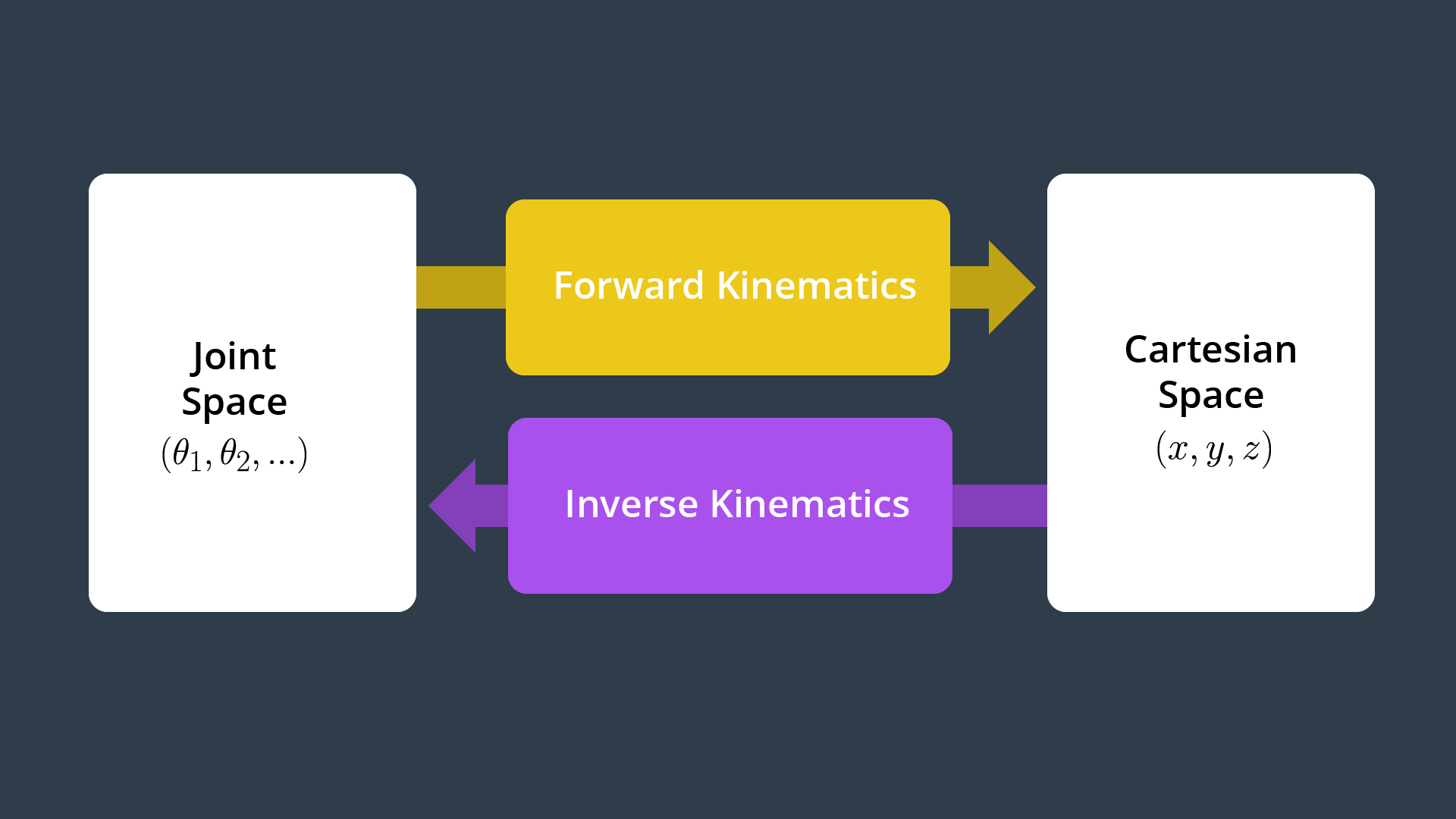
  • forward kinematics: joint space (theta1,theta2) -> Cartesian space (x,y,z)
  • inverse kinematic
To fully describe the configuration of a rigid body in 3-dimentional free space, you will need to specific 6 coordinates.
Joint types:
Smiley face
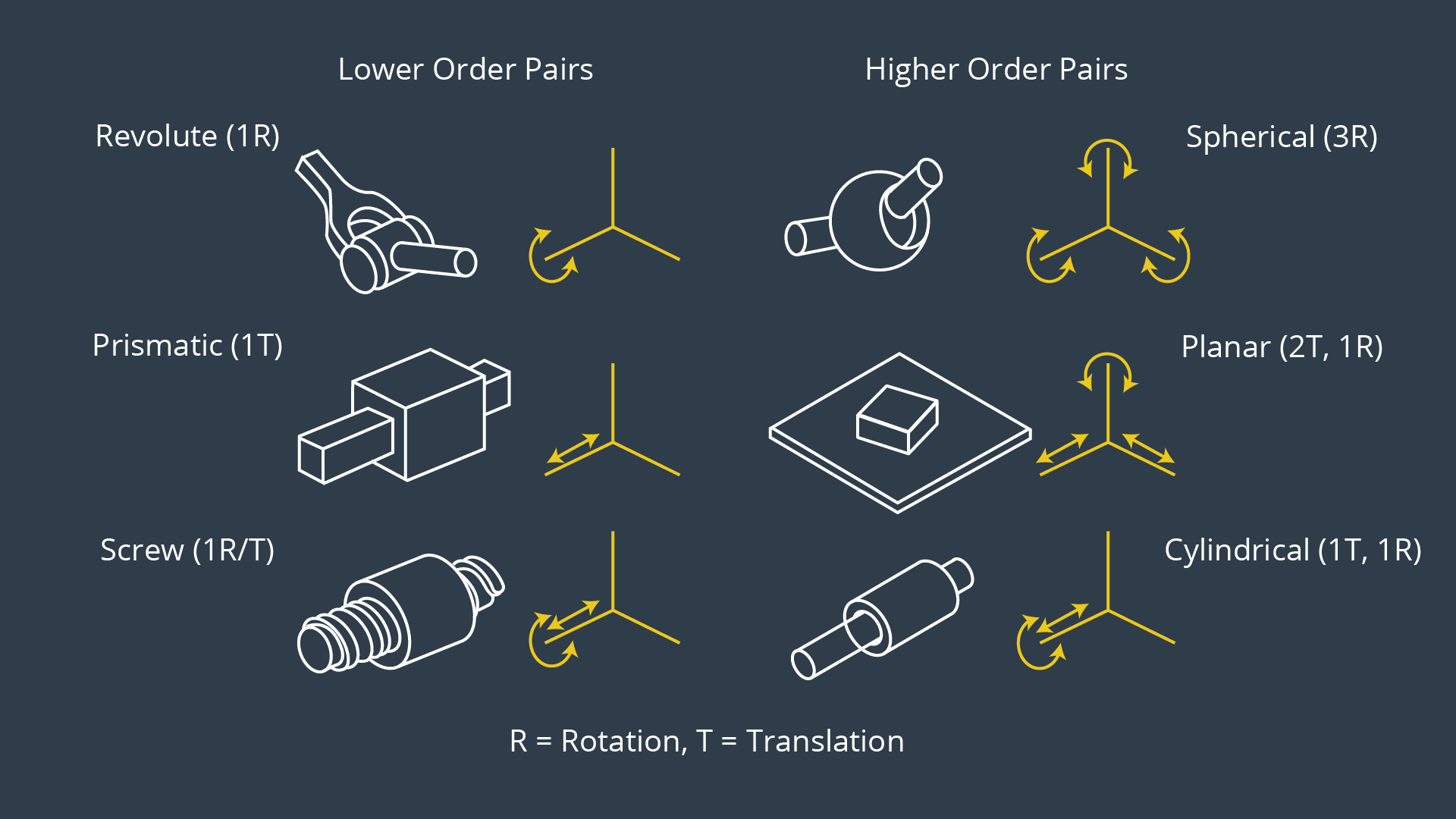
Rovolute Joint: It rotate along a specific axis.
Prismatic joint: provides a linear sliding movement between 2 bodies, and is often called a slider, as in the slider-crank linkage.
End effector: the device at the end of a robotic arm, designed to interact with the environment.
Joints can be grouped into lower order pairs having one DoF and higher order pairs offering two or three DoF. For serial manipulators (a.k.a., robot arm or kinematic chain), the most common joint types are revolute and prismatic allowing one rotational and one translational DoF, respectively.
Two rigid bodies in free space connected by a one DoF revolute joint would only have a total of 6 +1 = 7 DoF. For modeling purposes, higher order pairs are always replaced by a collection of lower order pairs, e.g. the revolute and prismatic Joint, each with 1 DoF. For serial manipulators with only revolute and/or prismatic joints, the number of degrees of freedom is always equal to the number of joints.
A typical serial manipulator has 6 degree of freedom: the first 3 joints control the location of the wrist center, while the last 3 only control the orientation of the end effector. A sphereical wrist has 3 DoF.
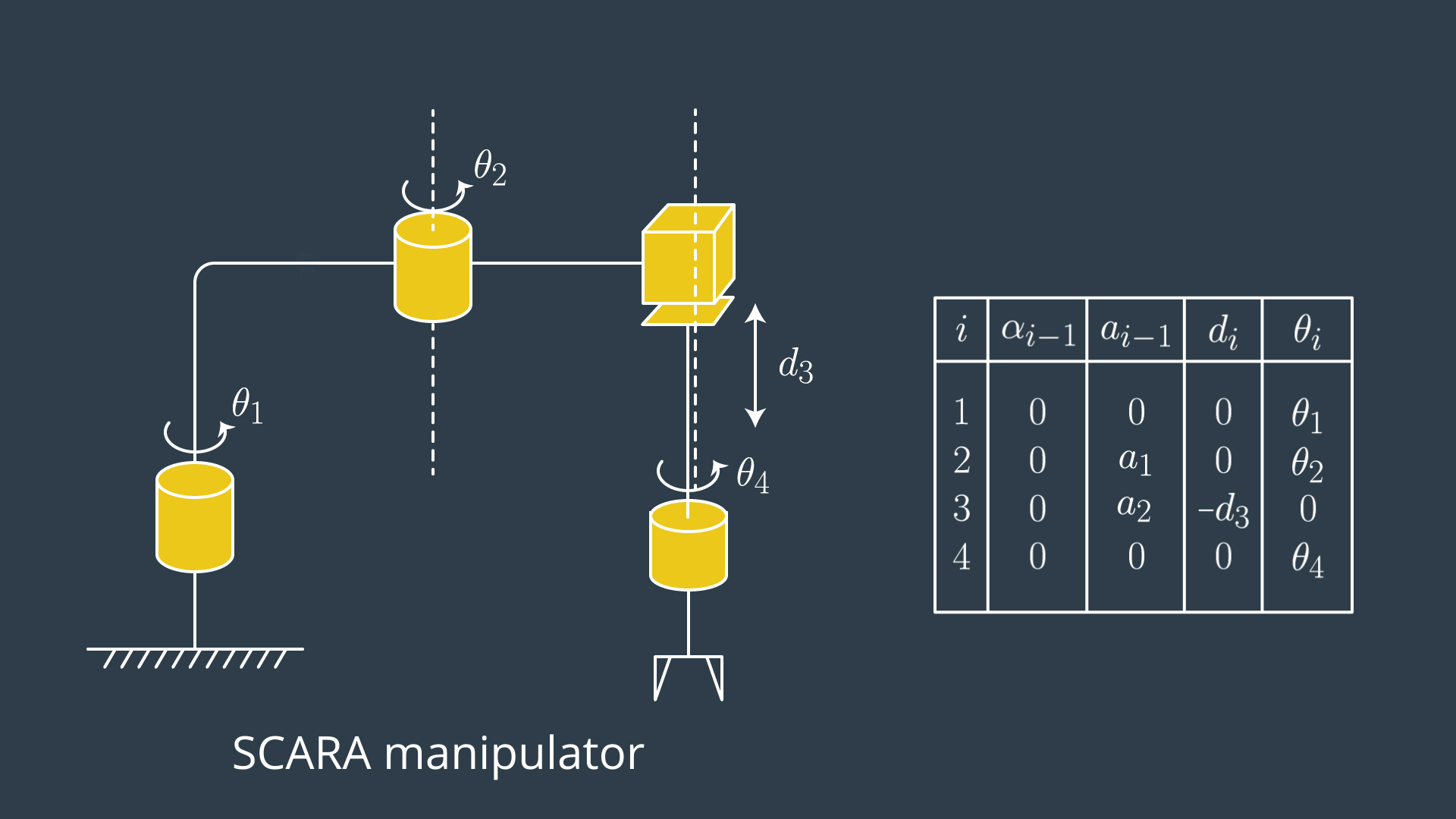
With only revolute and prismatic joints, there are only 8 possible permutations of arm types. But only 4 types are commonly used in industry: Cartesian (PPP), Cylindrical (RPP), Anthropomorphic (RRR), Scara/Spherical(RRP).
workspace: the set of all points reachable by the end effector.

What this course is about?

Given a robotic arm, we can know the parameters of the orientation and relative distance of each joint,
Forward kinematic problem: assume we know the rotation angle and translation distance, how can we express end effector’s position, either in analytical formula or numerical values?
Inverse Kinematic problem: we alway know the target position, how can we derive the angle and translation distance for each joint?

2.3 Rotation matrix

Rotation matrix solves the problems that 2 frames have different orientations.
Given: point (ux,uy) in frame B, angle theta from frame A to B.
Ask: what’s (vx,vy) in frame A for the same point? frame A can be considered as the orginal frame or the world map.
The rows of R are the projection of the A-frame onto B.
Features of Rotation matrices:
  • orthonormal matrices
  • The transpose is equal to its inverse
  • the determinant is equal to 1
3D Rotation matrix: elementary rotation.

2.6 Rotations in Sympy

from sympy import symbols, cos, sin, pi, simplify
from sympy.matrices import Matrix
import numpy as np
q1, q2, q3, q4 = symbols('q1:5')
R_x = Matrix([[ 1,              0,        0],
              [ 0,        cos(q1), -sin(q1)],
              [ 0,        sin(q1),  cos(q1)]])
R_y = Matrix([[ cos(q2),        0,  sin(q2)],
              [       0,        1,        0],
              [-sin(q2),        0,  cos(q2)]])
R_z = Matrix([[ cos(q3), -sin(q3),        0],
              [ sin(q3),  cos(q3),        0],
              [ 0,              0,        1]])

2.7 composite rotation

Euler angles: a system to describe a sequence of rotations. The orientation of any rigid body with respect to some fixed reference frame can always be described by 3 elementary rotations in a given sequnece.
Several convection:
  • Intrinsic rotation, body fixed. use new axis. post-multiply
  • Extrinsic rotation, fixed axis. use original axis. Pre-multiply
Rotations do not obey the commutative law of multiplication. The order matters.

2.8 from rotation matrix to Euler Angle

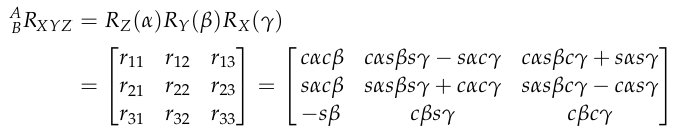
Consider the extrinsic (i.e., fixed axis) X-Y-Z rotation sequence. The composite rotation matrix is,
An inverse inferring to get \alpha,\beta,\gamma is possible. e.g. \beta = atan2(sin(\beta),cos(\beta))= atan2(-r31, \sqrt())
mport numpy as np
from sympy.matrices import Matrix
from sympy import symbols, atan2, sqrt
# Conversion Factors
rtd = 180/np.pi
dtr = np.pi/180
# Fixed Axis X-Y-Z Rotation Matrix
R_XYZ = Matrix([[],[],[]])
r11,r21,r31 = R_XYZ[:,0]
r32,r33 = R_XYZ[2,1:3]
### Euler Angles from Rotation Matrix
alpha = atan2(r21, r11) * rtd
beta  = atan2(-r31, sqrt(r11*r11 +r21*r21)) * rtd
gamma = atan2(r32, r33) * rtd

2.9 Translations

Note that translation only applies to different frame with the same orientation.
^Br_{P/B_o} indicates the position of point P relative to Bo, the origin of frame B. The leading superscript is to denote that this vector is expressed in the B frame. In other words,
The goal then is to describe P relative to Ao, ^Ar_{P/A_o}
Because both frames have the same relative orientation, describing P relative to Ao only requires simple vector addition:

2.10 Homogeneous Transform

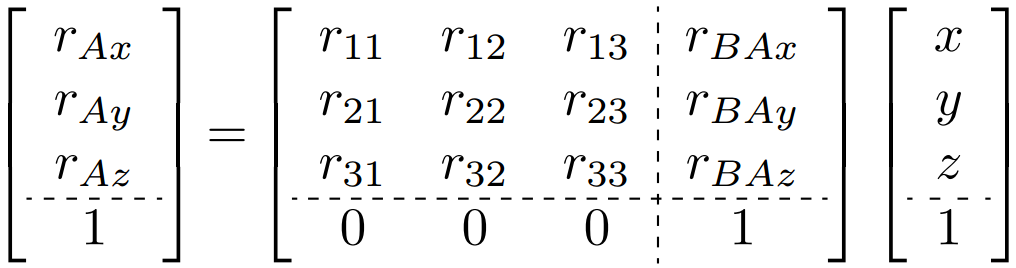
simultaneously rotated and translated with respect to each other:
The marix representation is designed as:
To be more specific:
The 4x4 matrix called a homogeneous transform.
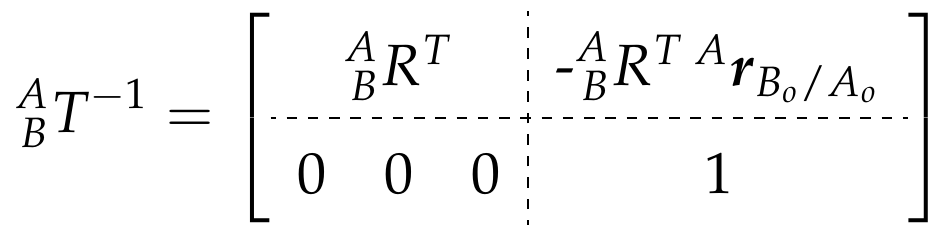
The inverse transform from B to A is:

2.11 Composition of Homogeneous Transforms

Intrinsic rotation, post multiply. The interesting thing is you treat the point as a static point, only the reference frame is changed.

2.12 DH parameter (KR 10)

In general, each transform would require six independent parameters to describe frame i relative to i-1, three for position and three for orientation.
In 1955, Jacques Denavit and Richard Hartenberg proposed a systematic method of attaching reference frames to the links of a manipulator that simplified the homogeneous transforms. Their method only requires four parameters to describe the position and orientation of neighboring reference frames.
Several modifications have been made to the DH method. The four most common sources are listed below,
  • Waldron, KJ. A study of overconstrained linkage geometry by solution of closure equations, Part I: A method of study (1973). Mech. Mach. Theory 8(1):95-104.
  • Paul, R. (1982). Robot Manipulators: Mathematics, Programming and Control (MIT Press, Cambridge, MA)
  • Craig, JJ. (2005). Introduction to Robotics: Mechanics and Control, 3rd Ed (Pearson Education, Inc., NJ)
  • Khalil, W and Dombre, E. (2002). Modeling, Identification and Control of Robots (Taylor Francis, NY)
In this course, we will be using the convention described in John J Craig’s book.
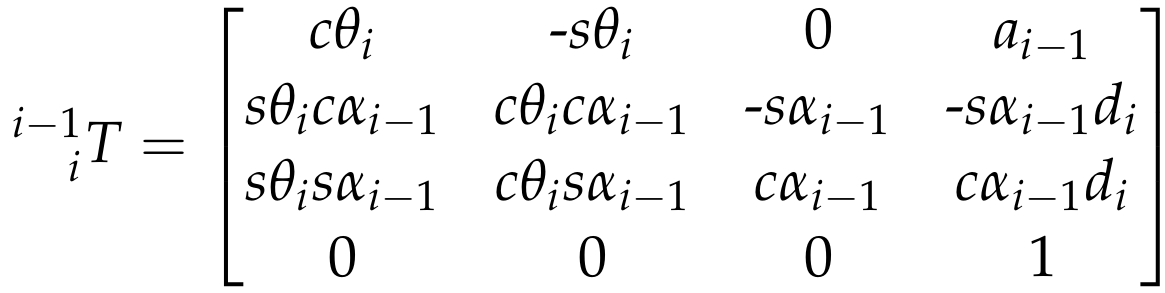
The homogeneous transform from frame i-1 to frame i is constructed as a sequence of four basic transformations, two rotations and two translations as follows:
The parameter names and definitions are summarized as follows:
  • αi−1 (twist angle) = angle between Z^i−1 and Z^i measured about X^i−1 in a right-hand sense.
  • ai−1 (link length) = distance from Z^i−1 to Z^i measured along X^i−1 where X^i−1is perpendicular to both Z^i−1 to Z^i
  • di (link offset) = signed distance from X^i−1 to X^i measured along Z^i. Note that this quantity will be a variable in the case of prismatic joints.
  • θi (joint angle) = angle between X^i−1 to X^i measured about Z^i in a right-hand sense. Note that this quantity will be a variable in the case of a revolute joint.
there is only one parameter that is variable (either θi or di), the link length and twist angle are constants.Thus, for the entire transform from base link to end effector, ^n_0T, there are only n-variables.
An example of an actual SCARA robot (RRPR) is the KUKA KR10, which is suitable for pick and place operation.
Detailed explanation refers to section 13-16.
Smiley face

2.17 Forward/Inverse Kinematics

Smiley face
Two approaches to solve IK problem:
  1. numerical/Newton_Raphson algorithm: guess and iterate. different initial conditions must ben used, no guarantee the algorithm will converge
  2. analytical/closed-form solution
Fortunately, most industrial serial manipulators satisfy the conditions solvable by the 2nd approach. In particular, the last 3 joints are revolute joints which form a spherical wrist with a wrist center (WC). Such design kinematically decouples the position and orientation of the end effector. So the problem is divided into 2 basic steps.
1st, get the wrist center position in the base frame. The confusing thing here is that ^6r_{EE/WC} is in the frame 6. We intentional manipulate the frame EE so these two align (same orientation) and ^6r_{EE/WC} simply becomes (0, 0, -d).
$^0r{EE/0} =[^0_6R,^0r{WC/0}]\times[^6r{EE/WC},1]^T=^0_6R\times ^6r{EE/WC}+^0r_{WC/0} $
$\rightarrow ^0r{WC/0} =^0r{EE/0}-^06R\times ^6r{EE/WC}=(px,py,pz)-d(r13,r23, r33) $
^0r_{EE/0} is the position of end effector and ^0_6R can be directly calculated from the orientation of the end effector, i.e. euler angle (roll, pitch,yaw).
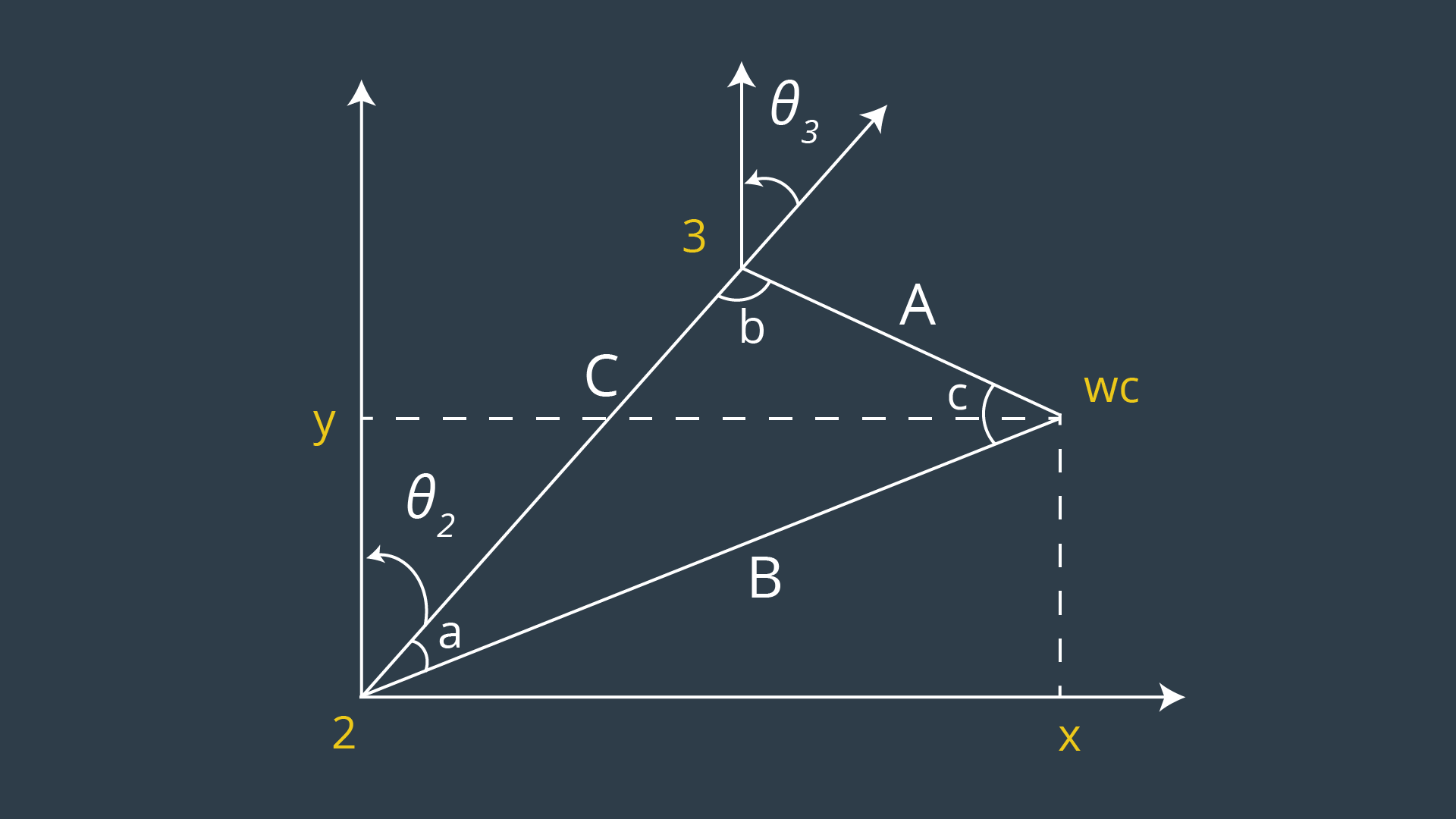
2nd, calculate the angles of first 3 joints by the Wrist Center using cosine laws
Smiley face
With these 3 angles, calculate the ^0_3R, then get ^3_6R, the remaining angles can be calculated by the matrix element.
R3_6 = R0_3.inv("LU") * ROT_EE
theta4 = atan2(R3_6[2,2], -R3_6[0,2])
theta5 = atan2(sqrt(R3_6[0,2]*R3_6[0,2] +                                         R3_6[2,2]*R3_6[2,2]),R3_6[1,2])
theta6 = atan2(-R3_6[1,1],R3_6[1,0])

project

solution codes at time 7:20

project steps:

  1. setup your environment
  2. explore the forward_kinematics with Kuka KR210 to learn more about the robot’s geometry and derive DH parameters
  3. Once you have the DH parameters, run the complete pick and place project in demo mode to get an understanding of the complete project scenario.
  4. perform Kinematic Analysis of the robot and derive equations for individual joint angles. In addition, you will write the actual Inverse Kinematics code inside of IK_server.py file with proper comments
  5. make a brief writeup report. The github repository has a writeup_template.md that can be used as a guide.
tools:
  • Gazebo, a physics based 3D simulator extensively used in the robotics world:
  • RViz, a 3D visualizer for sensor data analysis, and robot state visualization:
  • Moveit!, a ROS based software framework for motion planning, kinematics and robot control:
While your python script only solves IK for a specific 6DOF (6 joints) robot arm (Kuka KR210), there are generalized libraries and plugins which can be used to solve IK for different types of robots. A couple of widely used solutions are:
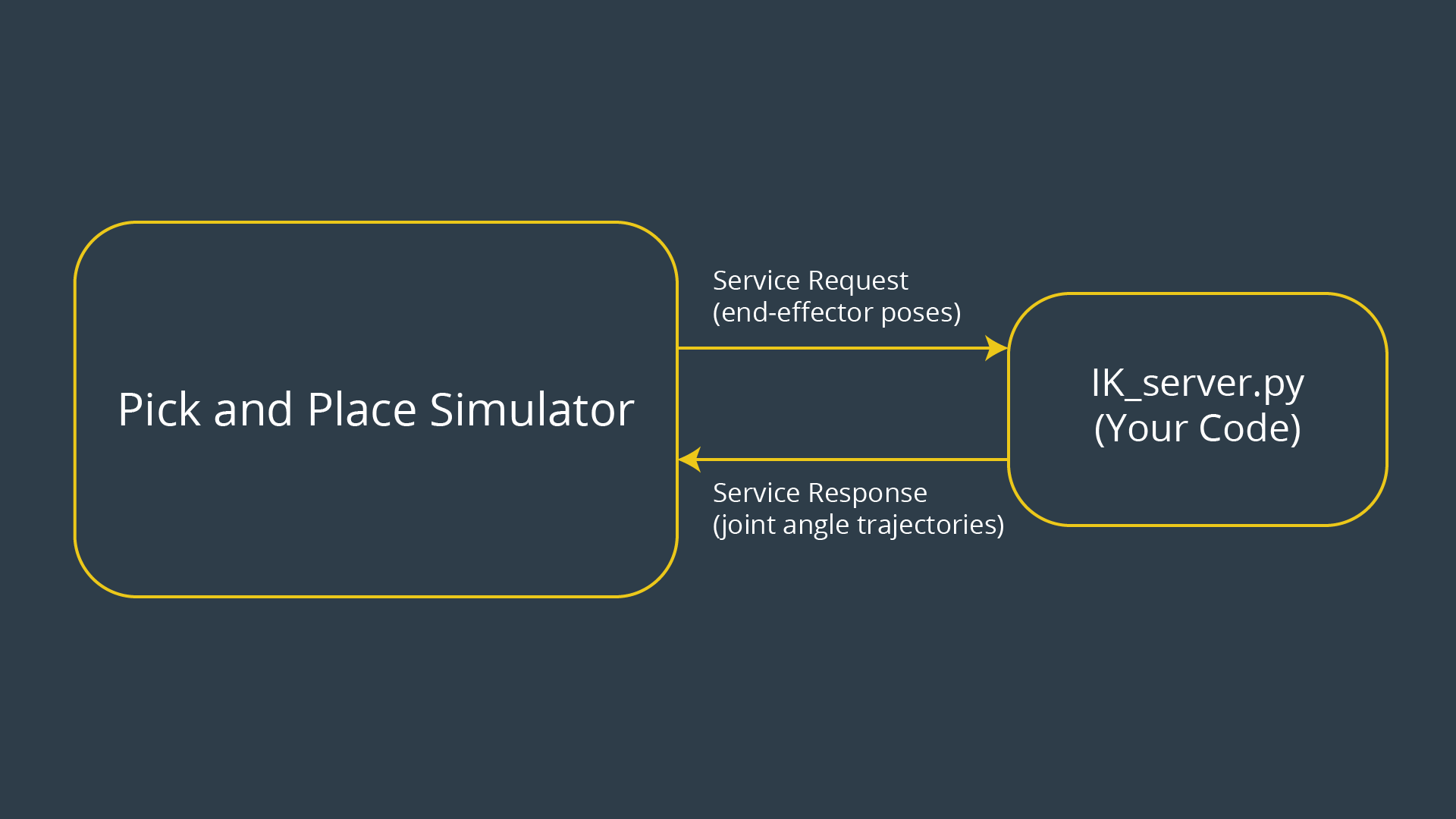
Inverse Kinematics: given a list of end-effector poses, calculate joint angles.

demo

set /kuka_arm/launch/inverse_kinematics.launch ‘s related flag to true.
$ echo "export GAZEBO_MODEL_PATH=~/catkin_ws/src/RoboND-Kinematics-Project/kuka_arm/models" >> ~/.bashrc
# write model path variable into bash file
$ gzserver
$ gzclient
$ gazebo  # run both
$ roscore
$ rosrun rviz rviz
$ roslaunch kuka_arm load_urdf.launch
# in Global Options, change world to base_link
$ roslaunch kr210_claw_moveit demo.launch
$ cd ~/catkin_ws/src/RoboND-Kinematics-Project/kuka_arm/scripts
$ ./safe_spawner.sh  # begin demo, it acutally did:
# roslaunch kuka_arm target_description.launch
# roslaunch kuka_arm cafe.launch
# roslaunch kuka_arm spawn_target.launch
# roslaunch kuka_arm inverse_kinematics.launch
$ roslaunch kuka_arm forward_kinematics.launch
$ rosrun tf tf_echo base_link link_6
# position and orientation data of 2 frames
Unified Robot Description Format or urdf, is an XML format used in ROS for representing a robot model. We can use a urdf file to define a robot model, its kinodynamic properties, visual elements and even model sensors for the robot. URDF can only describe a robot with rigid links connected by joints in a chain or tree-like structure. It cannot describe a robot with flexible links or parallel linkage.details: https://classroom.udacity.com/nanodegrees/nd209/parts/7b2fd2d7-e181-401e-977a-6158c77bf816/modules/8855de3f-2897-46c3-a805-628b5ecf045b/lessons/91d017b1-4493-4522-ad52-04a74a01094c/concepts/304b7bc0-6fe8-4614-bd09-4a545665adad
within kuka_arm/urdf/:
  • kr210.urdf.xacro - this file contains all the robot specific information like links, joints, actuators, etc.
  • kr210.gazebo.xacro - this file contains gazebo specific information like robot material, frictional constants, and plugins to control the robot in gazebo
MoveIt! does not have an inbuilt motion planning algorithm. Instead it provides a convenient plugin interface to communicate with and use various motion planning libraries.Moveit! utilizes a special ROS Service to establish a request-response relationship with any given motion planner.
At various stages in the process of motion planning, Moveit! needs to convert the joint_state of the robot into the end-effector pose using Forward Kinematics, and vice-versa using Inverse Kinematics.
Smiley face
While your python script only solves IK for a specific 6DOF robot arm (Kuka KR210), there are generalized libraries and plugins which can be used to solve IK for different types of robots. A couple of widely used solutions are:
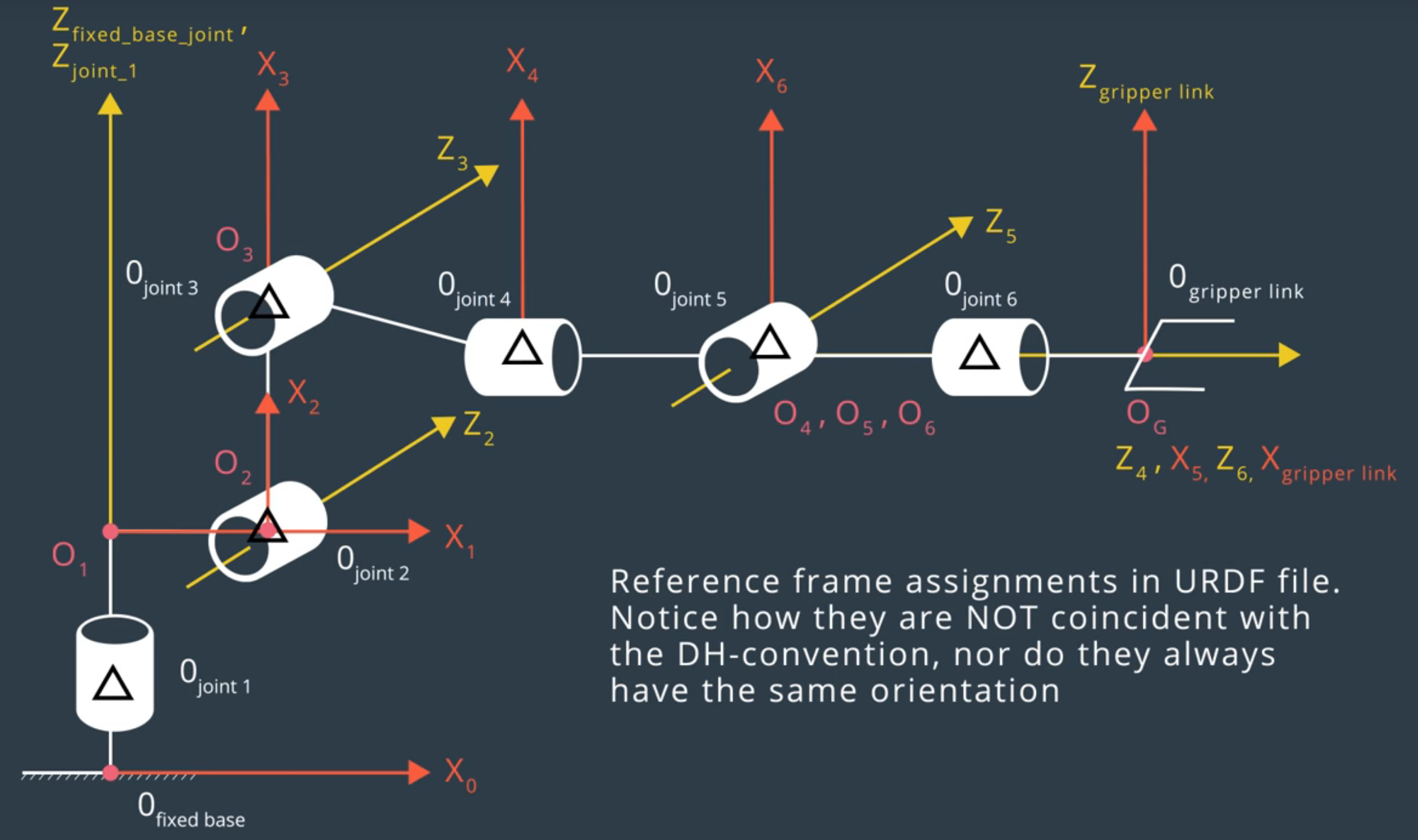
The important detail to remember is that our URDF model does not follow the DH convention; the frames from your DH parameter table will NOT always match the default orientation of the KUKA arm in RViz and/or gazebo.

IK_debug.py

A typical test case is
[[EE position],[EE orientation as quaternions]],[WC location],[joint angles] with size of 3,4,3,6. The first 2 vectors can used as input, and the last 2 vectors can be used for checking the IK results.
Smiley face
And the table is
Links alpha(i-1) a(i-1) d(i-1) theta(i)
0->1 0 0 0.75 qi
1->2 - pi/2 0.35 0 -pi/2 + q2
2->3 0 1.25 0 q3
3->4 - pi/2 -0.054 1.5 q4
4->5 pi/2 0 0 q5
5->6 -pi/2 0 0 q6
6->EE 0 0 0.303 0
kr210.urdf.xacro file shows the relative position between current joint and its parent joint. The choice of x-y-z axis for each frame follows the rules of minimizing the number of non-zero parameters.
For example, the d value of joint 1 can be chosen to be 0.33 or other arbitrary number. But it is better to choose x1 axis to be intersected with next joint, which can reduce the number of non-zero parameters. As a result, D is chosen to be 0.75 for joint 1.
To run the code
# change the flag of "inverse_kinematics.launch" to false
$ cd ~/catkin_ws/src/RoboND-Kinematics-Project/kuka_arm/scripts
$ ./safe_spawner.sh  # 
# open another terminal
$ rosrun kuka_arm IK_server.py